Finding a sperm donor in South Africa is a huge step. Whether you connected through a mutual friend, an online co-parenting platform, or a community group, the moment you have a willing donor is the moment your path to parenthood gets very real.
But it also raises a wave of new questions. What does the law say? Does your donor need to be tested? What actually happens on insemination day? And do you need a clinic, or can you do this at home?
This guide walks you through everything that comes after "yes" -- so you can move forward with clarity, confidence, and the right tools in hand.
First, Understand What the Law Says in South Africa
Before anything else, it helps to know where you stand legally when using a known sperm donor in South Africa.
Two pieces of legislation govern donor conception here: the Human Tissue Act of 1983 and the Children's Act of 2005. Together they set out who counts as a parent, what rights a donor holds, and how donor-conceived children can access information about their origins later in life.
The most important thing to know: a sperm donor in South Africa has no automatic parental rights or responsibilities over any child conceived through artificial fertilisation. Under Section 40 of the Children's Act, the donor is not recognised as a parent, and no obligations arise between the donor and the child -- unless a separate legal agreement has been structured to allow for co-parenting involvement.
This is very different from unprotected intercourse, where paternity can be established and legal duties follow.
South Africa also allows advertising for a free sperm donation, and reasonable reimbursement of a donor's time and expenses is permitted. What is not legal is paying for sperm in a commercial sense.
Do You Need a Written Donor Agreement?
Yes - and the earlier you have one, the better.
A written known donor agreement does not have the same legal force as a surrogacy agreement confirmed by the High Court, but it serves a critical practical purpose: it makes everyone's intentions clear before emotions, relationships, or circumstances change. It sets out things like whether the donor will have contact with the child, whether they will be known to the child, and what role (if any) they expect to play.
For same-sex couples, this document is especially important. A 2022 Gauteng High Court ruling confirmed that the non-birth mother in a lesbian couple conceived through donor insemination has the right to be registered as a parent - but navigating Home Affairs without documentation from the outset has caused real problems for families in South Africa. Getting legal clarity before insemination happens protects everyone involved.
Speak to a family law attorney who specialises in assisted reproduction before you proceed. It is not expensive to draw up a basic agreement, and the peace of mind is worth every rand. You can also download a sample contract here
Get Your Donor Screened
This is non-negotiable.
Before any insemination takes place, your donor needs to be tested. Fresh, unscreened sperm from a known donor carries real risk - sexually transmitted infections, including HIV, can be transmitted, and certain genetic conditions are also worth ruling out.
At a minimum, ask your donor to get tested for:
-
HIV (ideally within the same month as insemination)
-
Hepatitis B and C
-
Syphilis
-
Chlamydia and gonorrhoea
-
CMV (cytomegalovirus)
A basic semen analysis is also worth doing. This checks for sperm count, motility (how well the sperm swim), and morphology (the shape of the sperm). Poor sperm quality is one of the most common reasons home insemination takes longer to work -- and knowing your donor's numbers upfront means you can plan your cycles realistically rather than wondering after six attempts why it hasn't worked.
Most private labs and GPs in South Africa can arrange these tests. Your donor should be comfortable doing this - if they are not, that tells you something important.
Track Your Fertile Window Before the Appointment
Timing is everything in home insemination. You can have a healthy donor, great sperm quality, and a well-executed insemination - and still miss the window entirely if ovulation tracking is not accurate.
The fertile window is roughly six days per cycle: the five days before ovulation and the day of ovulation itself. But the highest-probability window is narrower - around 24 to 36 hours before ovulation and the day of.
The best way to catch this is with ovulation predictor kits (OPKs), which detect the surge in luteinising hormone (LH) that happens just before the egg is released. When your LH surge is positive, insemination should occur the same day and, ideally, again the following day.
Many people also use a basal body temperature (BBT) thermometer alongside OPKs. BBT rises slightly after ovulation has already occurred, so it is most useful for confirming that you ovulated and identifying patterns over several cycles.
If you have irregular cycles, PCOS, or are not sure when you ovulate, tracking for two to three cycles before your first insemination attempt gives you a much clearer picture.
Choose Your At-Home Insemination Kit
Once your legal and health foundations are in place, things become wonderfully practical.
A good insemination kit takes the guesswork out of the physical process. You do not need clinical training to do this at home - you need the right tools, used correctly, at the right time.
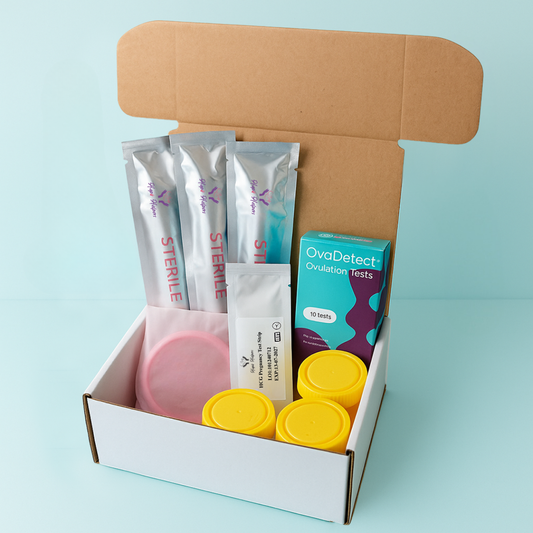
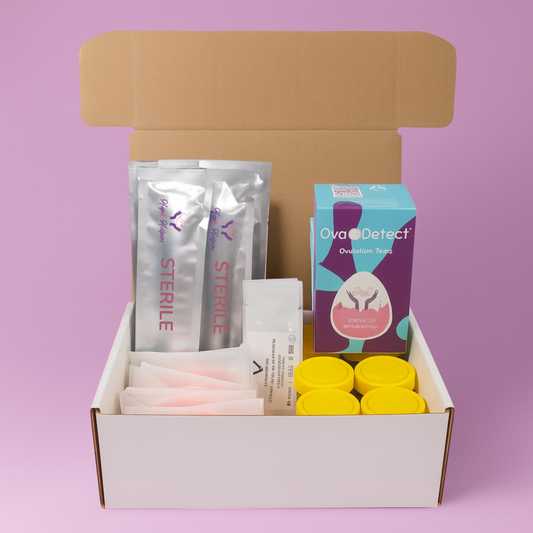
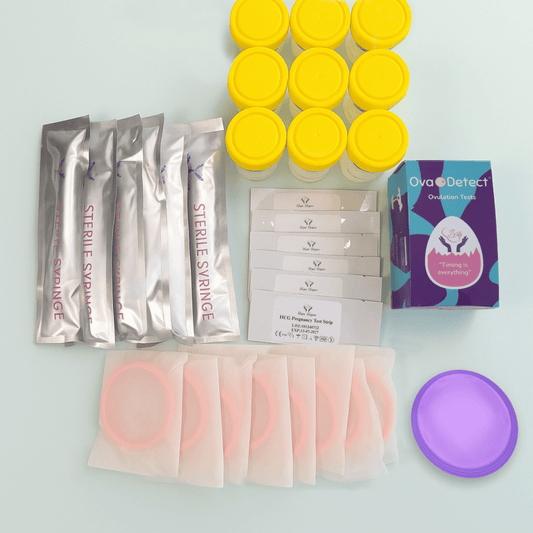
Here is what a quality kit should include:
A sterile specimen collection cup. Your donor collects their sample directly into this. Sterile, sealed, and ideally pre-labelled. Using a clean but non-sterile container risks contaminating the sample.
A round-tipped insemination syringe. This is used to draw up the sample and deposit it into the vaginal canal. The rounded, flexible tip makes insertion comfortable and minimises the risk of irritation. You are aiming for the semen to be placed as close to the cervix as possible.
A cervical disc or soft disc. This is one of the most underrated tools in at-home insemination. After the syringe is used, a disc is inserted to hold the semen in place near the cervix while you lie down. It significantly reduces the amount of semen that flows back out, keeping the sperm where they need to be for up to 12 hours. You can wear it while you rest, sleep, or even go about your day.
Ovulation test strips. Catching the LH surge in real time, on the day it matters.
Pregnancy test strips. For the two-week wait that follows.
At Home Insemination Solutions ZA, the kits are assembled specifically for this journey - by two women who used the exact same process to conceive. The Dinky Kit is a great starting point for a first cycle. The Mezzo and Stellar kits provide enough supplies for multiple rounds, which is realistic given that home insemination typically requires more than one attempt.
On Insemination Day: What to Expect
The day itself is simpler than most people expect. Here is a straightforward walkthrough:
Step 1: Confirm your LH surge is positive. Test in the morning and again in the early afternoon if you are unsure. Insemination should happen the same day as your surge, or the day after.
Step 2: Your donor collects the sample. They ejaculate into the sterile specimen cup. Seal the lid immediately. The sample should be used within 30 to 60 minutes, when sperm motility is at its best. Fresh sperm outside the body begins to decline in quality after about an hour.
Step 3: Allow the sample to liquefy. Let the sealed cup sit at room temperature for 15 to 20 minutes. Semen is initially thick and liquefies naturally in that time, making it easier to draw into the syringe.
Step 4: Draw up the sample and inseminate. Lie on your back with your hips slightly elevated (a pillow under your pelvis works well). Draw the semen gently into the syringe, being careful not to introduce air bubbles. Insert the syringe into the vaginal canal and slowly press the plunger. Aim to deposit the sample as close to the cervix as possible.
Step 5: Insert your cervical disc. Immediately after the syringe is removed, insert your disc. This keeps the sperm in contact with the cervix while you rest.
Step 6: Lie still for 15 to 30 minutes. You do not need to stand on your head - but gravity is your friend here. Lying down keeps the sample close to where it needs to be.
That is it. The disc can stay in for up to 12 hours. After that, remove it, and move into the two-week wait.
What About Success Rates?
Realistic expectations matter. At-home insemination using a known donor with fresh sperm has success rates of roughly 10 to 35 percent per cycle, depending on age, sperm quality, and how accurately ovulation is timed. That range is similar to a healthy couple conceiving naturally through intercourse.
Most people need between 2 and 6 cycles to conceive. This is not failure - it is biology.
The cost comparison is one of the strongest arguments for the at-home route. A single IUI cycle at a South African fertility clinic typically costs between R8,500 and R10,000, not including sperm, medications or consultations. A full insemination kit from Home Insemination Solutions ZA, including multiple rounds' worth of supplies, costs a fraction of that.
A Note for Same-Sex Couples and Single Women in South Africa
South Africa is one of the most legally progressive countries in the world for LGBTQ+ family building. Same-sex marriage has been legal since 2006. Single women - including lesbians - have had the legal right to access artificial insemination since 1997.
If you are a lesbian couple conceiving with a known donor, both partners can be recognised as parents. But this process requires you to be proactive. As covered above, a court order confirming parental rights for the non-birth mother before or shortly after birth is the safest route. Home Affairs does not always apply the law correctly at registration, and having documentation removes that friction.
If you are a single woman using a known donor, the donor has no parental rights by default under the Children's Act - as long as the conception is via artificial fertilisation rather than intercourse. Your agreement with the donor should reflect exactly what role, if any, they will play.
Your Checklist: Everything to Sort Before Insemination Day
-
Written donor agreement drafted with a family law attorney
-
Donor STI screening complete (HIV, Hep B, Hep C, syphilis, chlamydia, gonorrhoea)
-
Semen analysis done
-
Ovulation tracking started (OPKs + BBT thermometer)
-
At-home insemination kit ordered and ready
-
Fertile window identified for your upcoming cycle
-
Plan for the two-week wait in place (rest, support, and a pregnancy test for day 14)