


Reliable at detecting even very early pregnancy. Below is my test 8 day post ovulation. More cost effective and environmentally-friendly too thank other options.
HcgDetect 10 mIU Early Detection Pregnancy Test Strips
HcgDetect 10 mIU Early Detection Pregnancy Test Strips
Couldn't load pickup availability

Taryn's recommendation
Since you added this item to cart you might also need ... 👇🏻

Imagined by display:bold;  — Get in Touch
What's in the pack
-
✓
Your choice of 10 or 20 individually sealed hCG test strips -
✓
10 mIU/mL sensitivity, among the most sensitive available for home use -
✓
Results in 3 to 5 minutes from a small urine sample -
✓
Clear control and test lines, easy to dip, wait and read -
✓
Compact strips designed for repeat daily testing -
✓
Pairs with our urine collection cups
This is for you if
- You're in the two-week wait and want to test early without a pharmacy trip each time
- You'd rather test daily and watch for a line than buy one expensive digital test
- You've done at-home insemination and want to check at the right point
- You want the sensitivity of an early-detection test at strip prices
- You're tracking a line getting darker over several days and need more than one test
Details
Why 10 mIU sensitivity matters
The number on a pregnancy test that actually matters is its sensitivity, and this is where cheap and premium tests genuinely differ.
Sensitivity is measured in mIU/mL, and it's the smallest amount of hCG a test can detect. hCG is the hormone your body starts producing once an embryo implants, and it climbs quickly in early pregnancy, roughly doubling every couple of days. A test rated at 25 mIU needs your levels to reach 25 before it shows a line. A 10 mIU test, like these, can pick it up at less than half that, which in practice can mean detecting a pregnancy a few days earlier.
Those few days are the entire point of an early-detection test. They're also why strips make more sense than a single boxed test for anyone in the two-week wait. When you're watching for a faint line that gets clearer each morning, you want to be able to test freely rather than weighing up whether to "waste" your one expensive test today. A pack of ten or twenty removes that maths entirely.
A note on reading results honestly: testing this early does mean testing before a missed period, and very early pregnancies don't always progress. An early positive that later becomes a negative is something these sensitive tests can reveal, which is worth knowing going in. For the clearest single result, testing from the day your period is due, with first morning urine, is the most reliable.
How to use it
Collect first morning urine in a clean, dry container, since that's when hCG is most concentrated. Hold the strip by the handle and dip the arrow end into the urine for 5 to 10 seconds, without going past the MAX line. Lay the strip flat and wait 3 to 5 minutes. Two lines means positive, even if the second line is faint. One line (the control only) means negative. No control line means the test is invalid and should be repeated with a fresh strip.
If your period doesn't arrive and you've had a negative, test again in a couple of days, as your hCG may simply have been too low to detect the first time.
Reading a faint line
A faint second line is still a positive. In early pregnancy, hCG is often only just above the test's threshold, so the line can be pale before it strengthens over the following days. If you're unsure, test again 48 hours later, when a genuine pregnancy will usually show a clearly darker line.
Storage
Store sealed in a cool, dry place below 30°C. Use each strip immediately after opening its pouch.


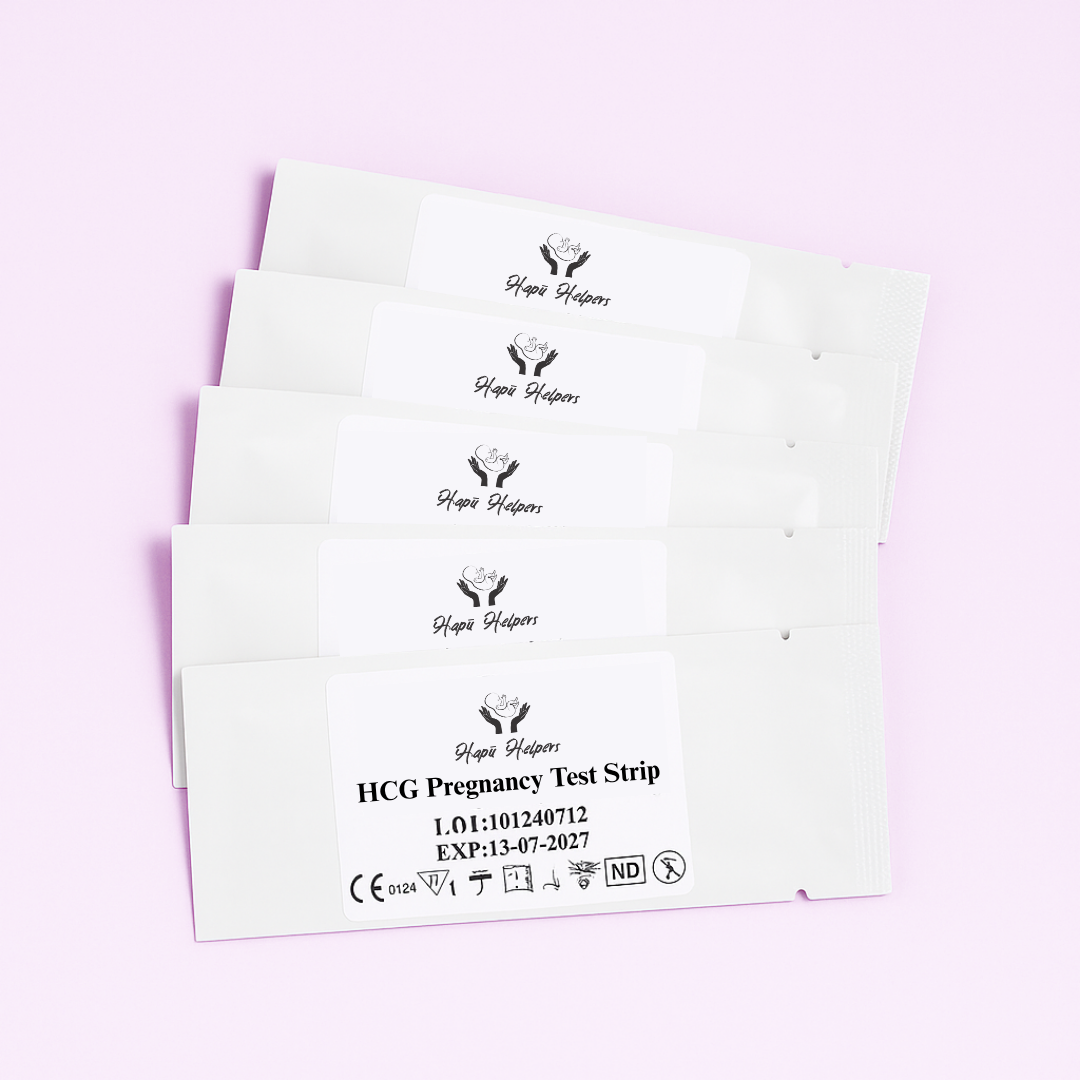
See how this product works...
The two-week wait is the hardest stretch of any cycle, and pregnancy tests are quietly designed to make it more expensive than it needs to be. A single early-detection test from a pharmacy can cost more than a whole pack of these, which nudges you into testing once, on the "right" day, and sitting on your hands until then. Anyone who has actually been through it knows that's not how it goes.
These strips are built for how people really test: early, often, and watching for a line that gets a little clearer each morning. 10 mIU sensitivity means you're not waiting longer than you have to, and buying ten or twenty at once means you never have to decide whether today's test is worth using. Same detection science as the expensive boxed tests, without the packaging or the markup.
They pair with our urine collection cups, and they're a natural companion to the ovulation strips, since the two bookend the same cycle: one to find your window, the other to find out whether it worked.
- 10 mIU sensitivity for early detection, from 10 to 14 days post-ovulation
- Packs of 10 or 20, so you can test freely through the two-week wait
- Clear results in 3 to 5 minutes, same science as premium boxed tests
About the hCG Test Strips
How early can I take a pregnancy test?
These strips can detect pregnancy from about 10 to 14 days after ovulation, which is often a few days before a missed period. Testing earlier than that risks a false negative simply because hCG hasn't built up yet. For the most reliable single result, test from the day your period is due, using first morning urine.
What does 10 mIU mean?
It's the test's sensitivity, the smallest amount of hCG it can detect, measured in mIU/mL. At 10 mIU these are among the most sensitive strips available for home use, so they can pick up a pregnancy earlier than standard 25 mIU tests.
What does a faint line mean?
A faint second line is still a positive. Early on, hCG levels are often only just above the detection threshold, so the line can be pale before it darkens over the next few days. If you're unsure, retest 48 hours later and look for a stronger line.
How accurate are these strips?
Used correctly with first morning urine at the right point in your cycle, hCG strips are highly reliable. Accuracy drops mainly when you test too early or don't follow the timing. A positive result should be confirmed by your doctor or clinic.
How many strips come in a pack?
You can choose a pack of 10 or a pack of 20. Many people prefer the larger pack so they can test across several days of the two-week wait without running out.
Can I use these after home insemination?
Yes. Test 10 to 14 days after the day you inseminated, which is when hCG would be detectable if implantation has occurred. Testing sooner may give a negative even if you have conceived.
What's the difference between these and ovulation strips?
They detect different hormones and are used at opposite ends of the cycle. Ovulation (LH) strips find your fertile window before you try. hCG strips detect pregnancy afterwards. If you're doing both, they're sold separately so you can stock the right number of each.
Why buy strips instead of a boxed pharmacy test?
Cost and freedom to test. A single early-detection boxed test often costs more than a full pack of these strips. The detection method is the same, so strips let you test as often as you like through the two-week wait without it adding up.
Where can I buy hCG pregnancy test strips in South Africa?
Here, delivered nationwide in 2 to 3 business days. We keep them affordable and in multipacks because testing through the two-week wait shouldn't mean rationing or repeated pharmacy trips.